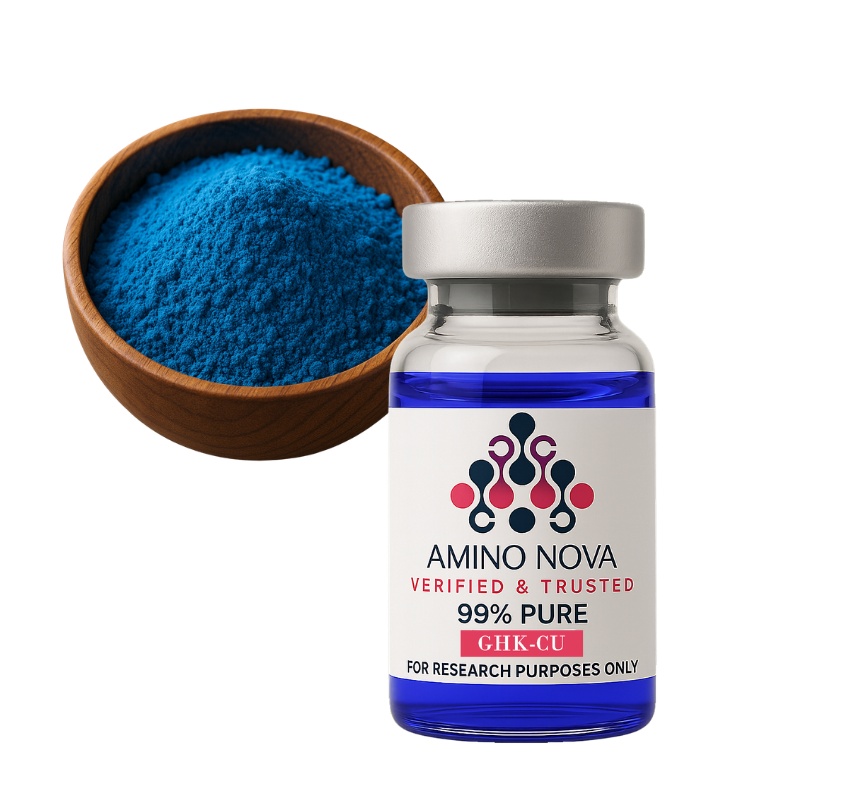
Description
Chemical Composition
Peptide sequence: Gly-His-Lys (C14H24N6O4 when free)
Metal ion: Cu2+ (copper in its divalent oxidation state)
Complex name: Copper tripeptide-1 or GHK-Cu complex
Molecular formula (approximate): C14H24CuN6O4
Molecular weight: ~401.91 g/mol
Molecular Structure
GHK peptide: A short tripeptide composed of three amino acids — glycine, histidine, and lysine.
-
Glycine provides structural flexibility due to its small size and lack of a bulky side chain.
-
Histidine acts as the primary copper-binding residue through the nitrogen atoms in its imidazole ring.
-
Lysine contributes to overall stability and increases the peptide’s interaction with biological molecules through its positively charged side chain.
When copper binds to the peptide, the histidine imidazole nitrogen, along with other donor atoms from the peptide backbone, forms coordination bonds with the copper ion. This chelation stabilizes the copper within the peptide complex, forming the biologically active GHK-Cu complex.
The copper ion typically adopts a square planar or distorted square planar coordination geometry, allowing the peptide to maintain strong metal binding while remaining biologically active.